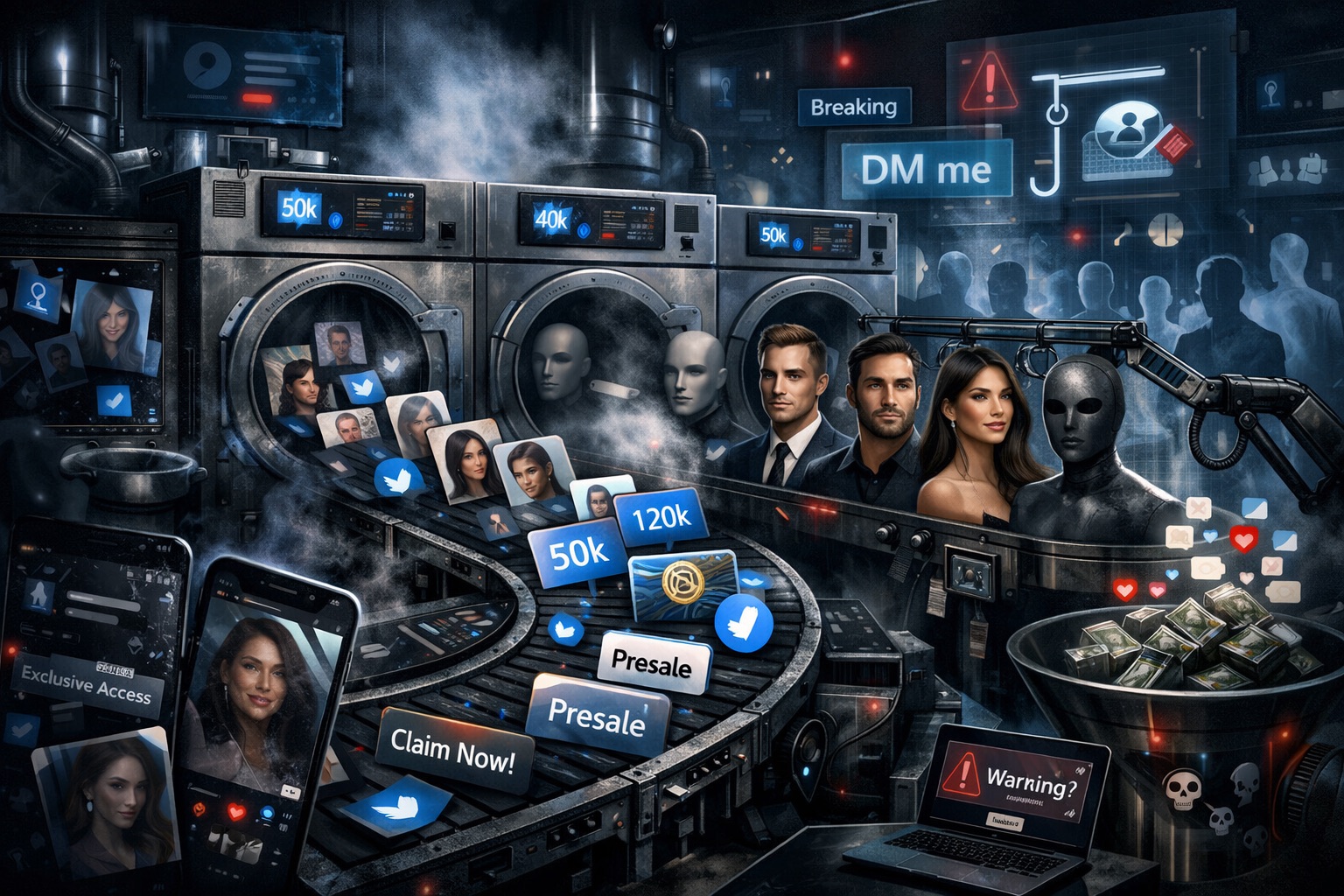
The Account Laundromat
TL;DR;
Old X accounts are being repurposed into whatever sells, manipulates, or extracts best at the moment: crypto startups, political insiders, meme traders, AI founders, or parasocial personas. The account is not the product. Trust is.
By keeping the follower count, account age, and surface legitimacy while deleting the old history, operators can recycle credibility into new scam funnels again and again. What looks like “organic audience” is often just identity laundering for monetization.
How old X accounts are recycled into crypto scams, political personas, and parasocial traps
There is a specific kind of weirdness on X that starts to stand out once you notice it.
An account with tens of thousands of followers appears to be a crypto startup. It has a polished avatar, a clean bio, a launch roadmap, and the right tone of synthetic seriousness. It posts about a presale, teases allocations, hints at “early access,” and builds just enough momentum to look real.
Then it disappears.
Not because the account is gone, but because the identity is.
A few weeks later, the same account is something else entirely. Now it’s a political persona. Then later it becomes a trader account, an AI founder, a meme account, or a thirst-trap persona designed to farm attention and DMs. The handle changes. The display name changes. The profile photo changes. The bio changes. The old tweets are gone. The follower count remains.
And that is the tell.
This is not just account hacking in the narrow sense, and it is not just ordinary “rebranding.” It is something more useful to scammers and growth operators: identity laundering.
The account is treated like a shell company for credibility.
The scam is not always the link
A lot of scam analysis starts too late.
It begins at the wallet drainer. The fake mint. The malicious claim page. The suspicious token presale. The phishing site. That part matters, of course. But by the time the user reaches the malicious link, the real manipulation has often already succeeded.
Because the first scam is not the transaction.
The first scam is the account itself.
An account with age, followers, and enough residual legitimacy can do something a brand-new scam account cannot: it can borrow trust from the platform’s visual shortcuts.
People still rely on a handful of social cues to decide whether something is real:
- follower count
- account age
- mutuals or familiar-looking engagement
- a “clean” profile
- some existing momentum in the algorithm
- a tone that sounds like it belongs
That is enough for most people to stop asking harder questions.
Scammers know this. So instead of building trust from zero, they acquire it second-hand.
The real product is not the audience. It’s the costume.
If you look at these accounts as “influencers,” they make very little sense.
If you look at them as convertible scam infrastructure, they make perfect sense.
An old account with 40,000 or 80,000 followers is not valuable because the followers are loyal. Often they are not. Many may be inactive, low-quality, or outright fake. But that misses the point.
The value is in what the account can still signal:
- “This account has been around for years.”
- “Other people must trust it.”
- “It looks too established to be fake.”
- “It already has distribution.”
- “It can get replies and impressions without starting from zero.”
That is enough to create a temporary window of believability.
And for scam operators, temporary believability is all they need.
They do not need a durable brand. They need a credible skin for the next funnel.
That is why the same account can be repurposed from one niche to another with almost no shame or continuity. The persona is disposable. The follower shell is the asset.
From crypto launch to political insider to parasocial bait
The strange thing about recycled accounts is how often they jump between niches that seem unrelated.
A crypto account becomes a political account. A political account becomes an “OnlyFans woman” persona. A meme trader becomes an AI founder. A fake startup becomes an influencer account. At first this looks absurd, but the logic is simple.
The operators are not loyal to a subject. They are loyal to conversion.
Different identities unlock different extraction models:
Crypto persona
Useful for:
- fake token launches
- presales
- airdrop claims
- wallet connection scams
- Telegram/Discord migration
- affiliate extraction through “alpha” and fake conviction
Political persona
Useful for:
- ragebait monetization
- influence laundering
- engagement farming
- authority mimicry
- audience building through outrage and certainty
Parasocial / adult persona
Useful for:
- DM funnels
- subscription bait
- crypto “tips”
- private group funnels
- emotional manipulation
- clickthrough monetization
Founder / builder / AI persona
Useful for:
- fake products
- newsletter capture
- launch scams
- low-friction authority building
- investor / operator cosplay
From the outside, these pivots look random. From the operator’s point of view, they are just different wrappers around the same question:
What kind of identity will make the next extraction easiest?
That is why these accounts often feel hollow. They are not designed to express a person. They are designed to maximize conversion under changing market conditions.
Why old tweets get deleted
One of the most revealing behaviors in this pattern is the mass deletion of old posts.
That is not a minor detail. It is one of the clearest signs that the account is being prepared for reuse.
If someone simply changes interests, they usually leave behind some continuity. Old jokes, old photos, old arguments, old mutuals, old community traces. Real people tend to have residue. Their identities have seams.
Laundered accounts try to remove those seams.
Deleting the old timeline serves a few purposes at once:
- it removes obvious evidence of prior identities
- it makes the current persona look cleaner and more intentional
- it hides previous scam attempts or failed monetization runs
- it reduces the chance that casual viewers notice the account used to be something else entirely
What remains is a kind of synthetic freshness attached to inherited trust.
The account is not old in the way a real identity is old. It is old only in the ways that matter to conversion.
That is the trick.
The black market behind the surface
Not every recycled account comes from the same source, but the ecosystem likely includes several overlapping pipelines.
1) Hacked accounts
Some are simply stolen. Old creator accounts, startup accounts, abandoned meme accounts, and dormant personal accounts are all useful if they still carry follower count and age.
2) Aged account farms
Some accounts are created in bulk, lightly used, artificially aged, and then inflated with low-quality followers or synthetic engagement. These are sold later as “warm” accounts.
3) Account flipping and reselling
Some accounts are directly traded, leased, or passed between operators as monetizable shells.
4) Scam infrastructure reuse
Some are not sold publicly at all. They may just move internally between campaigns, niches, and operators as one funnel burns out and another begins.
The exact origin varies, but the economic logic is the same:
Why build trust slowly when you can buy the appearance of it immediately?
That is what makes this worth taking seriously. It is not just “weird internet behavior.” It is a scalable model for cheap manufactured credibility.
Why X is especially good for this
This phenomenon is not unique to crypto, but crypto fits it perfectly because crypto scams rely so heavily on social proof, urgency, and portable trust.
And X is one of the best platforms in the world for converting those things into clicks.
The platform rewards:
- speed over continuity
- novelty over memory
- virality over verification
- identity performance over identity consistency
That creates an environment where an account can change skins repeatedly while still benefiting from its previous life.
Most users do not audit identity continuity. They do not check what the account was called six months ago. They do not compare old replies to the current persona. They do not investigate whether the audience actually matches the account’s new niche.
They just see a clean profile and a large number.
That is enough.
The algorithm does not care whether the authority is authentic. It mostly cares whether the account can still generate attention.
That is exactly why these recycled shells remain useful.
The scam chain usually looks like this
The lifecycle is often much more systematic than it appears.
Step 1: Acquire a credibility shell
An operator gets access to an old account with age, followers, or engagement history.
Step 2: Strip its old identity
Delete the old tweets. Change the handle. Replace the avatar, display name, and bio.
Step 3: Install a monetizable persona
Turn it into whatever currently converts:
- crypto project
- trader account
- political insider
- adult persona
- startup founder
- “alpha” account
Step 4: Run extraction
Push the audience toward:
- a wallet connect flow
- a presale
- a private group
- a subscription funnel
- a referral scheme
- a hype cycle
- a phishing page
Step 5: Burn and reset
Once trust decays or reports accumulate, wipe the identity again and reuse the shell for something else.
The key point is that the operator does not need the identity to last.
They only need it to hold long enough to extract value.
That is why these accounts can survive multiple “lives.” The account is not meant to be believed forever. It only needs to be believed for long enough.
What makes these accounts so convincing
The danger is not that these personas are perfect.
The danger is that they are good enough.
Most online trust is built from incomplete signals. People are busy. They scan, they infer, they move on. Scammers do not need to defeat careful forensic scrutiny. They only need to survive casual inspection.
And casual inspection is exactly where these accounts perform best.
They often have:
- a polished profile image
- a short, plausible bio
- enough followers to look established
- some engagement to create movement
- just enough insider language to sound native to the niche
- just enough urgency to trigger action before reflection
That combination is deadly because it creates what scam operators want most: frictionless plausibility.
The account does not need to prove itself. It just needs to feel annoying to doubt.
How to spot a laundered account before it costs you money
Most people are still looking for obvious red flags like broken English or low follower counts. Those matter less than they used to.
The stronger question is not “Does this look fake?”
It is:
Does this identity have continuity?
That is what you should audit.
Check for niche discontinuity
Does the account’s current persona make sense relative to the replies, followers, or quoted posts around it?
If a supposed political insider has replies from old crypto bagholders, or an “OnlyFans creator” has a follower base that looks like AI spam and memecoin bots, something is wrong.
Check for unnatural cleanliness
A totally wiped timeline on an old account is not automatically proof of fraud, but it is a major reason to slow down. Real online identities usually have residue.
Check for abrupt authority
If an account suddenly appears fully formed as a founder, insider, builder, or project account with no believable history of becoming that, be skeptical.
Check for monetization speed
How quickly does the account move from “content” to extraction?
That extraction may be:
- “join the presale”
- “claim your allocation”
- “mint now”
- “DM for access”
- “join the private group”
- “subscribe for more”
- “connect wallet”
The faster the funnel appears, the less likely the identity is real.
Check whether trust is doing too much work
If your belief in the opportunity depends mostly on:
- follower count
- profile aesthetics
- social momentum
- vibes
then you are already in the danger zone.
That is exactly what these accounts are built to exploit.
The bigger point
Crypto scams are often described as technical attacks, but many of them are not technical first. They are social engineering systems wrapped around money.
That means the infrastructure of the scam is not only the smart contract, the wallet drainer, or the phishing page.
It is also the attention funnel.
It is the profile.
It is the follower count.
It is the inherited legitimacy of an account that no longer belongs to the identity it claims to represent.
That is what makes recycled X accounts so important to understand. They are not just a side curiosity of internet weirdness. They are one of the most efficient ways to manufacture temporary trust at scale.
And temporary trust is enough to steal a lot.
Final thought
A lot of scam victims later say some version of:
“The link looked legit.”
But often that is not the whole truth.
What really happened is that the account looked legit first.
And by the time the malicious link appeared, the scam had already done its job.
Because on today’s internet, credibility does not always have to be earned.
Sometimes it is just bought used, cleaned up, and put back on the market.
Read another editorial: “The Screenshot Economy: When Proof of Profit Became a Marketing Asset”
Anonymous feedback used to improve internal story ranking. No public totals are shown.
Share
Share this article
Share this article on social platforms.
Support ClusterWire
If you find ClusterWire useful, tips help cover hosting and infrastructure costs.
We record anonymous interactions with tip buttons to understand feature usage. We do not include IP addresses, user-agent strings, or wallet addresses in these tip analytics. Blockchain transactions are public and may reveal the sending address.
Updates and corrections
No changes recorded in the new revision log. Earlier edits may not be included.